
What Is the True Cost of Aging Concrete?
HeatROI AI evaluates the hidden heat, energy, carbon, deterioration and replacement costs of existing concrete infrastructure—and helps determine when maintaining, repairing, renewing, resurfacing or replacing an asset creates the strongest lifecycle outcome.
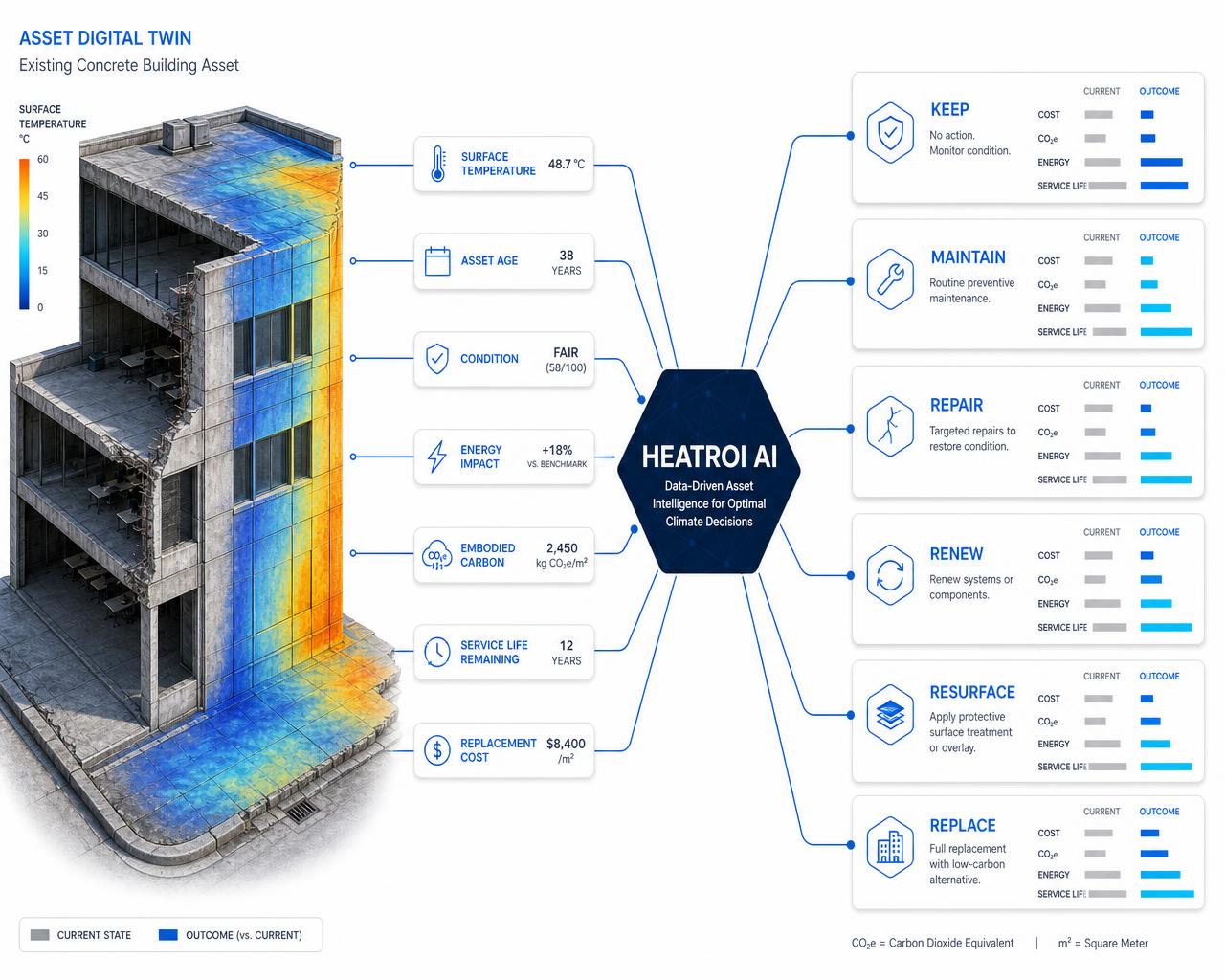
Illustrative interface concept. Values shown are placeholders, not measured results.
The World's Largest Concrete Opportunity Is Already Built.
Billions of tons of concrete already exist in buildings, infrastructure, pavements, roofs, facades and other assets around the world.
As those assets age, owners repeatedly face a critical decision:
Those decisions are typically fragmented across condition, cost, energy and engineering assessments. HeatROI AI is being built to connect those variables into a lifecycle decision platform for the existing concrete built environment.
Heat Has a Cost.
Sun-exposed concrete, masonry and other building surfaces can reach temperatures substantially above ambient conditions.
For appropriate building-envelope applications, this solar-driven thermal load can contribute to:
- Building heat gain
- Cooling demand
- Electricity consumption
- Peak electrical demand
- Occupant and surrounding thermal conditions
- Operational carbon emissions
HeatROI connects measured surface-temperature data, weather conditions, asset characteristics and energy information to estimate the economic and carbon consequences associated with heat.
Surface temperature and weather inputs are measured. Heat gain, cooling demand, energy cost and operational carbon are modeled estimates that depend on building characteristics, occupancy, HVAC systems and grid emissions factors.
Replacement Has a Carbon Cost Too.
Removing and rebuilding an existing concrete asset consumes new material and energy before the replacement delivers a single day of service.
Renewal is not always the lower-carbon or lower-cost outcome. HeatROI models and compares the alternatives for a specific asset rather than assuming a result.
From Asset Data to the Optimal Intervention
- · Type
- · Size
- · Location
- · Age
- · Construction
- · Surface deterioration
- · Cracking
- · Weathering
- · Existing finish
- · Remaining service-life indicators
- · Surface temperature
- · Thermal imaging
- · Solar exposure
- · Control measurements
- · Ambient temperature
- · Solar irradiance
- · Humidity
- · Climate
- · Orientation
- · Energy costs
- · Maintenance costs
- · Resurfacing costs
- · Replacement costs
- · Material quantities
- · Concrete / cement factors
- · Mortar and coatings
- · Transportation
- · Demolition
- · Electricity emissions factors
See the Carbon Consequences Before You Intervene.
The Carbon Ledger compares modeled lifecycle scenarios side by side so owners can weigh embodied carbon, energy impact, cost and service life together — not in isolation.
- Materials required—
- Estimated embodied CO₂e—
- Energy impact—
- Cost—
- Expected service-life impact—
- Materials required—
- Estimated embodied CO₂e—
- Energy impact—
- Cost—
- Expected service-life impact—
- Materials required—
- Estimated embodied CO₂e—
- Energy impact—
- Cost—
- Expected service-life impact—
- Demolition—
- Waste—
- New concrete / material—
- Transportation—
- Installation—
- Estimated embodied CO₂e—
- Cost—
- Expected service life—
Results are expressed as estimated avoided embodied carbon vs. replacement for a defined scenario and set of assumptions — never as an absolute carbon-reduction claim. Values populate only from asset-specific inputs, published emissions factors and documented assumptions.
Every Variable, One Decision
The lowest upfront-cost decision is not always the lowest lifecycle-cost or lowest-carbon decision.
The First Integrated Renewal Solution
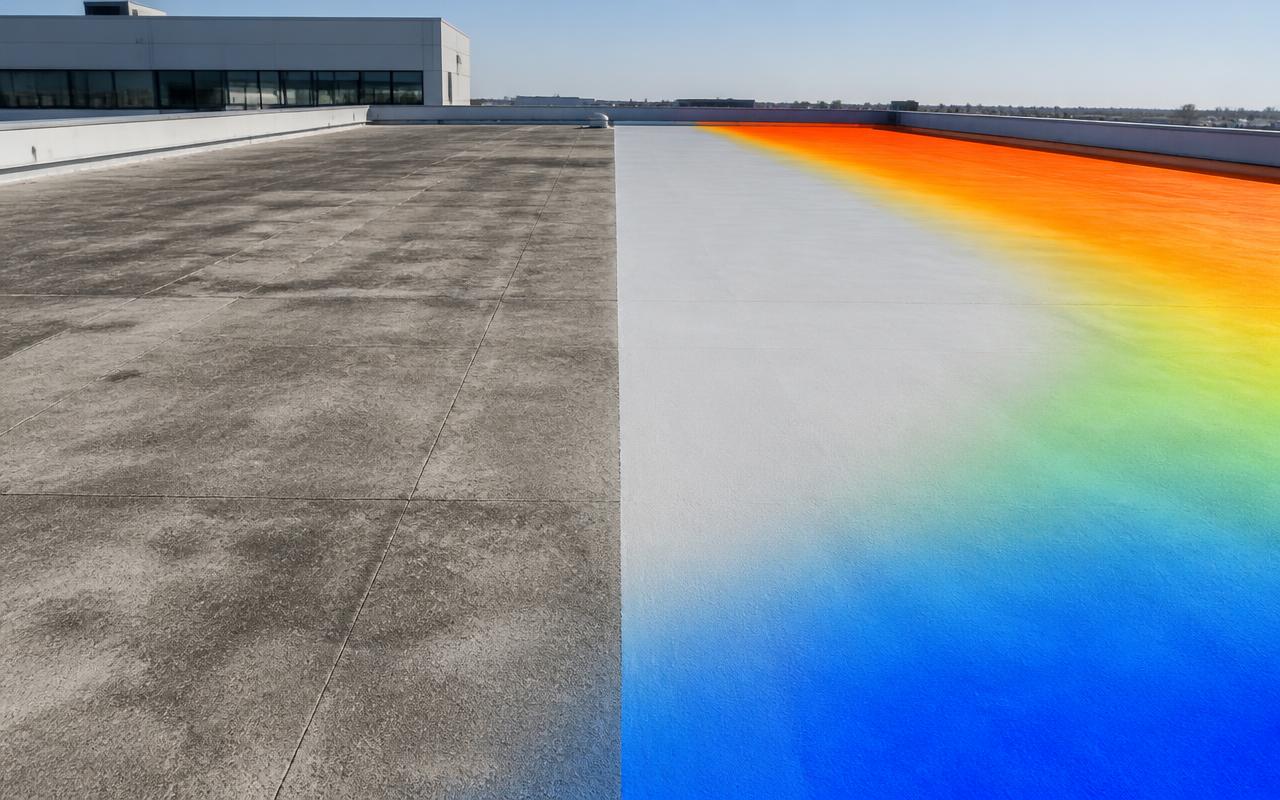
CoolCrete is a cementitious thermal surface renewal technology being developed for existing concrete, masonry, stucco and compatible mineral surfaces.
Rather than automatically removing and replacing an aging surface, CoolCrete creates another potential intervention for HeatROI to evaluate:
The objective is not to automatically recommend CoolCrete. The objective is to determine when CoolCrete produces the strongest lifecycle outcome — a distinction that is essential to platform credibility.
Predict It. Then Measure It.
Conventional lifecycle software stops at the prediction. HeatROI closes the loop by comparing predicted outcomes against measured field results and feeding the difference back into the models.
- · Baseline surface temperature
- · Weather conditions
- · Asset condition
- · Energy baseline where available
- · Estimated lifecycle carbon
- · Estimated replacement scenario
- · Predicted intervention outcome
- · CoolCrete
- · Concrete resurfacing
- · Mortar
- · Repair system
- · Alternative intervention
- · Surface temperature
- · Thermal imagery
- · Material performance
- · Environmental conditions
- · Energy performance where available
- · Condition over time
Extend the Concrete Value Chain.
HeatROI creates the potential for cement and concrete producers to participate beyond initial material production. Through lifecycle intelligence, renewal technologies and producer-manufactured solutions, companies can potentially participate throughout an asset's useful life.
From Concrete Producer to Lifecycle Materials Partner
CoolCrete is being developed with a scalable manufacturing and licensing model that could enable qualified cement, concrete and construction-material producers to manufacture and commercialize regional CoolCrete systems.
CoolCrete Is the Beginning. The Platform Is Bigger.
HeatROI's long-term objective is not to recommend one product. It is to determine which intervention creates the strongest lifecycle outcome for a specific asset.
Asset Classes HeatROI Is Being Built to Evaluate
Applicability is determined asset by asset. Inclusion here indicates a potential application, not validated performance for every surface or condition.
- · Stucco
- · Concrete facades
- · CMU / masonry
- · Tilt-up
- · Concrete roof tiles
- · Rooftop pavers
- · Concrete decks
- · Sound walls
- · Transportation concrete
- · Municipal assets
- · Precast
- · Warehouses
- · Hotels
- · Multifamily
- · Schools
- · Industrial facilities
- · Seawalls
- · Promenades
- · Marine concrete
- · Coastal infrastructure
Every Output Is Classified.
HeatROI never presents a modeled value as a measured fact. Each result carries a classification and a confidence indicator so sophisticated users can judge how reliable it is.
Concrete Should Have a Digital Lifecycle.
The concrete industry has spent decades optimizing how concrete is produced. HeatROI is focused on what happens during the decades after it is installed.
Every concrete asset should eventually have a digital lifecycle record containing:
HeatROI AI is building the intelligence layer to turn that information into better lifecycle decisions.